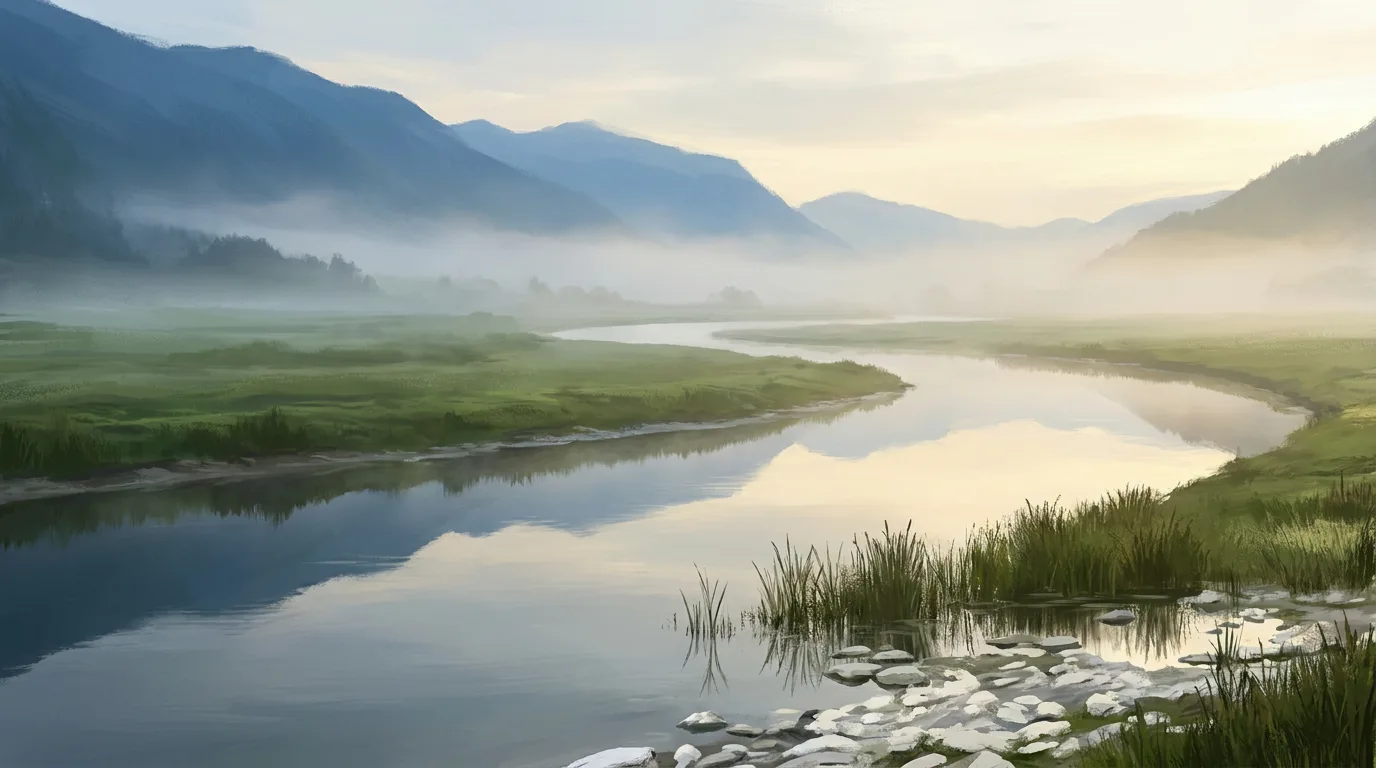
A painted wide river winding through a misty green valley toward distant blue mountains at first light

River Name Generator

Rivers, streams, and deltas named as compound hydronyms that sound centuries old.

River Name Generator

Generate names for rivers, streams, brooks, rapids, and deltas across six landscapes, built as compound hydronyms with an optional flow character - free and instant, right in your browser.

How rivers and streams get their names

A river name is one of the quietest pieces of worldbuilding and one of the hardest to fake. Readers rarely stop to admire it, but they notice instantly when it sounds wrong: too modern, too random, or lifted straight off a real atlas. Good waterway names feel like they were worn smooth by centuries of use. This generator builds them the way real ones were built: a landscape sets the flavor of the root, a waterway type sets the water word, and each result can carry a short note on how the water actually runs.

The compound hydronym, your signature tool

Most river names in English are compound hydronyms: a descriptive or place root fused to a water-meaning ending in a single word. The endings are a small, ancient set, and this generator uses that shape as its core. A root like Silver takes a suffix like -flow and becomes Silverflow; Aelden plus -mere becomes Aeldenmere; Frostvel plus -water becomes Frostvelwater. The suffix carries the meaning, so your ear accepts the whole word as water before you have consciously parsed it, which is exactly why an invented name like Mirefenrun reads as plausibly as any name on a real map. The suffixes span the full register too: a soft -mere for a still pool, a hard -race or -wash for fast water, a -burn or -fall for hill country and drops.

Four shapes, one water

Not every waterway wants a compound name, so the generator mixes four shapes. The compound hydronym is the workhorse. The bare form drops the water word entirely, because rivers people live beside often lose it in speech: they say the Sharnvel, not the Sharnvel River. The full descriptive form spells it out, root plus water word, as in Aelden River or Croakfen Rapids, and it always uses the waterway type you selected so a batch of brooks stays brooks. The epithet form names the water for its behavior rather than a place, giving you the Swift River or the Winding Delta. Choose a specific waterway type to lock the water word, or choose any to let each name roll its own, which is how a single region ends up with a river, two streams, a brook, and a delta that still sound related.

Consistency across a map

The fastest way to break a reader's trust is a map where every waterway sounds like it was named by a different person on a different day. Keep three things consistent. First, phonology within a watershed: rivers and their tributaries should share sounds, so generate several names in one landscape and assign the main river and its feeder streams from the same batch. Second, scale logic: a brook should feed a stream, a stream should feed a river, and a delta belongs only where a large river meets still water, so let the geography pick the waterway type. Third, let the flow character do quiet work: a river described as slow and silt-brown implies lowland farming downstream, while one that runs cold from the snowmelt implies mountains upstream you may not have drawn yet. When you need the land those waters run through, our sibling mountain name generator and forest name generator name the peaks and woods; this site deliberately owns the water. Everything generated here is free to use in personal and commercial projects alike.

Worked examples

Frequently asked questions

How do I come up with a good river name?
Real waterway names form in a handful of ways, and this generator follows them. The most common is the compound hydronym: an evocative root fused directly to a water-word ending, which is how you get names like Silverflow, Aeldenmere, or Wintrethburn in one word. The others are the bare poetic form (a river locals simply call the Sharnvel), the plain descriptive form (the root plus a full water word, as in Aelden River), and the epithet form (the Swift River, named for how it runs). Pick a landscape for the flavor of the roots and a waterway type for the water word, then generate until one sounds like it has been on the map for centuries.
What is a compound hydronym, and why does it sound right?
A hydronym is simply the name of a body of water, and a compound one is built from two parts fused into a single word: a descriptive or place root plus a water-meaning suffix such as -flow, -mere, -run, -burn, or -water. Most real river names in English work exactly this way, which is why a made-up name like Frostvelwater or Mirefenrun reads as instantly plausible even though you have never seen it before. The suffix does the heavy lifting: it tells the ear this is water, so the root is free to be pure atmosphere.
What is the difference between a river, a stream, a brook, rapids, and a delta?
Scale and behavior. A river is the main channel, large enough to anchor a region or a border. A stream is a smaller flow that feeds a river, and a brook is smaller still, the kind you can step across. Rapids are a stretch where the water breaks white over rock rather than a waterway in their own right, useful when you want the name to carry danger. A delta is where a river fans out into many channels as it meets the sea or a lake. The waterway selector stamps the matching word onto the phrase-shaped names, so your map's water vocabulary stays consistent.
Can I use these names in my novel, game, or D&D campaign?
Yes, that is exactly what the tool is for. The names suit fantasy novels, tabletop campaigns, video game worlds, interactive fiction, and worldbuilding wikis. Generate a batch, keep what fits, and feel free to recombine parts: take the root from one result and the suffix or water word from another, or promote a brook into a full river as your map demands.
Can I use a generated name commercially, in something I sell?
Yes. Names themselves are not copyrightable and we claim no rights over the generator's output, so you can use the results in commercial novels, games, brands, and products. Every root in the corpus is original invention; the tool contains no real river names and nothing from existing franchises. For a commercial project it is still worth running a quick search to confirm the exact name is not already a registered trademark in your market.
Is the generator free, and do you store what I generate?
It is completely free: no account, no daily limit, no premium tier. The generator runs entirely in your browser, so your selections and the names it produces never leave your device and nothing is stored on a server. Once the page has loaded it even keeps working if your connection drops.
How is this different from the mountain and forest generators?
They split the map by feature. This river generator names the water: rivers, streams, brooks, rapids, and deltas. The mountain generator at mountain.namesplease.app names peaks and ranges, the forest generator at forest.namesplease.app names woods, and the kingdom generator at kingdom.namesplease.app names the realms that contain them all. Name the landscape first, then name the river that runs through it so the two sound like they belong on the same map.

Guides